CE Accredited Mini Diggers: A Guide to Adherence
CE Accredited Mini Diggers: A Guide to Adherence
Blog Article
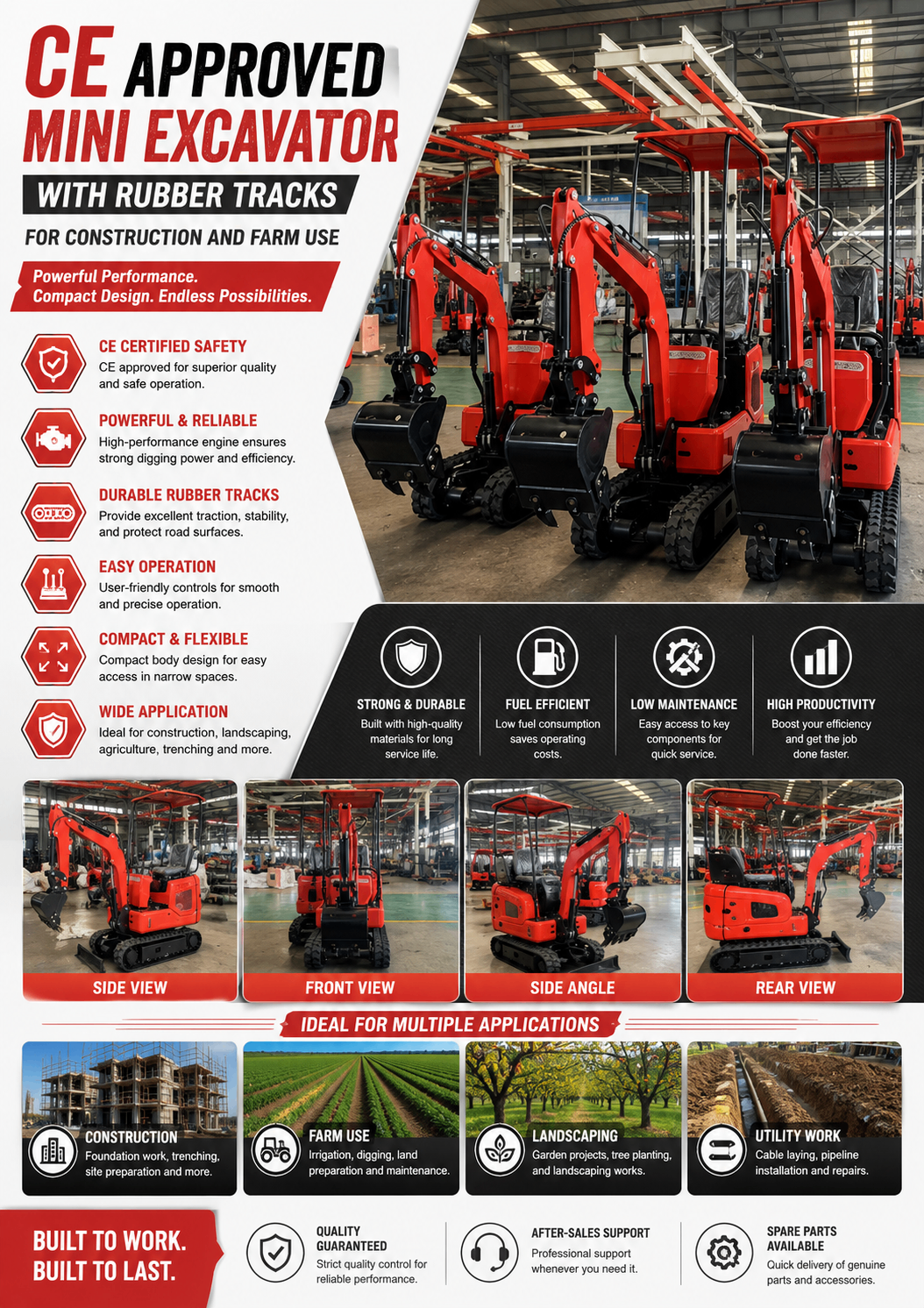
Ensuring your mini digger meets CE approval requirements is vital for market within European markets. Our handbook covers the key aspects of CE certification for small tracked machines, covering directives related to security, construction equipment assessment, and documentation. Understanding the requirements allows companies to safely deploy their machinery and prevent potential fines.
Rubber Track Mini Machines: Outstanding Grip for Tough Terrain
Mini diggers equipped with composite tracks are changing how contractors handle projects in demanding conditions. Unlike traditional tire-equipped models, these adaptable machines provide remarkable traction on unstable surfaces like sand, snow, and inclined slopes. This greater control allows operators to finish work securely and efficiently, lessening downtime and optimizing performance. The yielding nature of steel tracks also lessens ground impact, preserving delicate surfaces and minimizing environmental impact.
Compact Diggers: Impressive Output in Confined Building Areas
These robust smaller excavators provide a considerable solution for projects where traditional equipment simply work. Their limited profile permits access to difficult areas, including confined utilities or between existing buildings. Despite their scale, they feature substantial digging force and finesse, helping them perfect for a varied range of demolition functions. Ultimately, compact excavators represent a efficient asset for contractors facing the problems of restricted areas.
Compact Diggers for Agricultural Land : Flexibility and Effectiveness in Agricultural Tasks
Modern ranching operations often require tools that can handle a wide range of demanding jobs. Small machines are quickly becoming invaluable assets for farmers , offering exceptional flexibility and efficiency across a diverse array of agricultural operations . From digging for irrigation networks and drainage to relocating earth for creating enclosures or platforms, these pieces of equipment provide a capable solution. They furthermore excel at clearing land for cultivation, grading acreage , and processing materials with convenience. Their reduced footprint allows them to operate in tight spaces that larger tractors simply cannot navigate.
- Trenching for Irrigation
- Moving Soil
- Preparing Land for Planting
Selecting the Appropriate Mini Excavator regarding Building vs. Farm Uses
When evaluating a mini excavator , it's essential to understand the key distinctions between building projects and rural operations . Building sites often require greater power , exactness, and the capability to function in confined spaces . As Small construction excavator a result, a robust model with a extensive assortment of attachments might be preferable. On the other hand, farms frequently involve reduced digging amounts, routine landscape leveling , and the requirement for maneuverable equipment to move through open areas. In conclusion, careful assessment of the intended assignments is essential for securing the suitable decision.
- Think about excavation requirements.
- Assess the space constraints .
- Review the necessary implements.
- Take into account transportation challenges .
{CE Labeling & Mini Excavators : What Operators Require to Understand
Ensuring your {mini compact machine is compliant relevant European regulations is crucial, and that's where {CE labeling comes in . This identification demonstrates that the device has been assessed and meets safety requirements, allowing legal use within the European Economic Area . {For hirers of these machines, understanding CE marking is vital . It isn't simply about having a sticker on the digger; it represents a assessment of manufacturing and performance .
- Verify the existence of the CE identification.
- Consult the conformity document – this details the standards the machine meets.
- Consider that CE certification is the maker's responsibility – while operators must be aware of its significance.